
Module 1: Establish Authority
Establish Authority: FAQ
01. Define Your Target Market
How do I figure out who my ideal reader is?
I'm having trouble figuring out who my target market is! Help!
[progressally_vimeo_video id=’1′ vimeo_id=’362348069′ width=’600′ height=’350′ ]
I have a lot of data to go through! What do I do?
If you have a lot of data, you don’t necessarily have to go through every single piece of it. Prioritize the data from the top of the Most Valuable Reader pyramid. For example, here are a few specific situations you might find yourself in:
If you already have products or books for sale, then you have a shortcut. Your “super fans” are those people who have bought more than one of your products, shared about them on social media, written you emails about how great your products are (and why), and so on. As super fans, their words weigh at least 10x more than anyone else’s, so start there. If you can get 3 superfans on the phone or chat for a Target Market Chit-Chat, you’ll have what you need.
If you already offer services or work with clients, then you have a shortcut. Your “super fans” are those people who have worked with you not just once but on multiple occasions. They’ve referred their friends to you. They’re a delight to work with, and you experience a lot of personal satisfaction due to the transformation they’re undergoing. If you could clone this person 100x and fill your business with just them, you would! That’s your target market. Think specifically about this person when you’re working through this module’s assignments.
If all your data is online and you have lots to look at: Go slow and methodically look through it. Limit it to the last 2 or 3 years worth if you need to. You’re building a habit of listening. Right now it takes focused effort, but keep going through your data, reading between the lines and looking for clues. Eventually, this habit of listening for and to your target market will become second nature to you.
If you have a ton of blog comments, try this trick: Inside WordPress in the “Comments” section, sort by author (commenter) and quickly skim through to find multiple comments by the same author. (Doing this will also help you filter out your own comment replies.) Someone who comments frequently is definitely one of your fans. Also, you can click “Screen Options” at the top of the Comments page in your dashboard to display more comments at one time.
If you have a lot of emails from readers, try this: Search your inbox for the phrase “thank you” and prioritize reviewing the messages where a reader has expressed gratitude to you. When a message from a reader includes that phrase, often that reader feels like you’ve already helped solve a problem they’re experiencing. Pay special attention to what comes after the “thank you” because often, the reader will describe (sometimes in detail!) the transformation they experienced, and that is pure gold for your target market research.
Check out this Google Sheets template for organizing your data, also linked in the lesson. Note the two tabs at the bottom. Try copying this to your own Google Drive and using it as your Treasure Trove.
What if I don’t have many comments or emails from readers?
If you have a small online following and therefore not many people or comments to research, then you get to choose! Think about who you want to be a hero to and find this person in real life. Ask around in your Facebook groups. Ask your friends to introduce you to someone who fits that description. Then use the Target Market Chit-Chat Toolkit to guide you as you talk to those people.
For the chit-chats, would it be weird to email my list and say, "Anyone want to chat?"
I wouldn’t recommend emailing your whole list at this stage. You’re likely to get more responses than you need and then have to spend extra time turning people away. Instead, you could check your email list analytics to find a handful of your most engaged subscribers, then follow up with them individually.
Should I send my current subscribers a survey using the questions from the Target Market Questionnaire?
Don’t do a survey yet if you don’t already have one in place. The reason? You may want to save that for later in the program, when you’ll be learning specific things to ask your entire community. Don’t spend that amazing currency yet. Keep looking at the data already available in your community.
On the other hand, if you’ve already done a survey in the past, do go back through the results to look for clues, and listen to what your readers are telling you as you read between the lines.
I have a lot of "I love your blog!" or "I'm so happy I found your blog!" but what does that really tell me?
Dig deeper. Why did your reader like this post enough to comment? Try to take a step back and think about what makes THIS one special to that reader. Even if you don’t have a ton of hard data to go from, you’ll be picking up extra places to do this valuable research as we continue moving through the program. For right now, pull out the facts and move forward. Remember, keep going back to the why. And don’t forget to check other places for comments – Facebook, Instagram, Pinterest, and especially emails.
To show you how to look deeper, here are some example comments on a food blog, taken from one Blog Smarter student’s site, and what they could be saying:
“I was asked if I bought the cheesecake because my family couldn’t believe I could make something so pretty and delicious” » Gains: Their family is super impressed. Beautiful food means more recognition for the cook!
“I have now made this cheesecake at least 5 times and every single time I get rave reviews from my family! Tonight I made one for my sister’s birthday. Everyone always loves it, as do I!” » Gains: Praise and recognition; special enough for special occasions when she wants to impress others and show her love for them.
“I am actually enjoying my slice of cheesecake right now from my sister’s birthday…..it is divine! (Wish I could include a picture…I piped the frosting into Rosette’s and rimmed the edge with raspberries). Again, everyone LOVED IT! It is my go to recipe now for cheesecake that everyone requests!” » Gains: Praise and recognition; wants to put her own special touch on it to make it personal and special for a loved one.
02. Start Your Perspective Map
How do I find out the why? I feel like I’m just guessing.
Put yourself in the shoes of that reader. For example, a food blog might get comments like this: “I made this and it was great! Everyone in my family ate it.” What the reader is saying is this: “I have a hard time finding recipes that will please my whole family. This one fed everyone and I feel so good about it. I’m proud to have served it.” Do you see the why? Just keep thinking about her problem and what she wants to accomplish, think, do or feel.
Is it possible to have two target markets?
More details: I have two target markets. They do overlap, but they also have some very specific needs/goals that are quite different. Is it possible to have two target markets, or does that just end up diluting what you do? Would I just be creating extra work for myself?
Sometimes as bloggers, we have ideas about the direction we want our businesses to go that may not necessarily reflect the opportunities in front of us. It is possible to have two target markets, but it’s not a common path to success to start out with two distinct target markets at this stage. Keep in mind that stepping up to being a CEO means looking objectively at what’s in front of you and deciding what to do first. You have limited time and resources, so if you pursue very different markets at the same time, you risk not effectively reaching either of them. Can you hit the “pause” button on one of those target markets, so you can focus on the other and build your authority more quickly with them? (In the “Uncover Your Zone of Authority” lesson, you’ll see why this is an important question for this situation.)
That doesn’t mean that you’ll never help people outside of your target market. But at this point in the program, think about who that super fan is who you can serve best, but base that first on who is actually showing up – their struggles, their hopes, their needs. Try to set aside what you already think about the direction of your blog or topics you’d like to write. It’s easy to get ahead in your mind (we’ve all done it) but just start simple. In this module, focus on the person first, and eventually in a later module, you’ll have so much more clarity about the “how” – how you can help her, what she wants vs. what she needs, and so on. You will have some tough choices to make during this program, but knowing your ideal reader well will help with these big decisions.
I see 2 or 3 very clear target markets. Should I fill out a Perspective Map for each one?
Read the previous FAQ entry first, then come back here if you still have this question. This answer is primarily for bloggers with established authority in more than one area already – in other words, they have paying customers in more than one target market. If your separate target markets have very different challenges and goals, you can do a separate Perspective Map for each right now, and then after this module, you may get some clarity between these groups. At some point, you’ll need put on that CEO hat and choose a direction as your primary target market. But follow through with the research and see what themes surface from each Perspective Map.
Here’s a little forward thinking if you decide to fill out multiple Perspective Maps: Remember, this is for research purposes. This is a tool you will continue to build on throughout the rest of the program. Consider whether you want to continue researching both tracks for the purposes of this program, or if you want to focus on one target market for the duration of the program.
Would it make sense to choose a target market with more longevity over one that is transitory?
More details: For example, should I choose stay-at-home moms instead of pregnant women because you’re only pregnant for a limited amount of time?
It’s more what you have the longevity to write about and create products for. Pregnant people have babies and then have friends and coworkers and sisters who also have babies. The need is never ending. Word of mouth can be powerful. Or as another example, the wedding industry is billions per year – and top-to-bottom, a wedding takes only about a year (or less) until it’s planned and finished.
Also, look at what your readers are telling you. What are they already responding well to?
This sounds like “niching down.” Is that all we're doing here?
No because “niching down” is about your topic. Blog Smarter starts with the people.
The Blog Smarter framework doesn’t tell anyone to pick one topic over another (that’s your choice!). But if you’re truly wanting to grow your business, ask yourself: Which of your target market options presents the biggest business opportunity? In other words, are there lots of products you could recommend, products you could create or offer, and so on in that area?
I get emails asking for specific things. Is that my ideal reader?
Not necessarily. Try to go deeper than “my target market wants me to do xyz” and find out why she wants that. When you read between the lines, you’ll start to uncover common desires for your target market.
I've done this exercise before, so I was able to easily fill in the form. Do I really need to dig deep through the data?
More details: I feel like I know my audience pretty well already. Is this just an initial assessment that we’re going to continue to refine, or do we need to spend hours trying to dig deep through data?
Even though you’ve done a similar exercise before, try to push it a bit further. For example, you know what you think you know about your audience – but what does your data tell you? What is the underlying thing that’s important to your target market?
No need to spend a ton of time on digging through your data if you truly do have your finger firmly on the pulse of your target market already. But even if you already know exactly what your target market wants and needs so that you can deliver the perfect content and products to them, I still recommend you go through and collect quotes to use. Not just your words, but your actual readers’ words. Their words are a goldmine when it comes time to sit down and write marketing/sales copy for your products. And it’s something you can’t replicate. Copy and paste those little bits of language into your Treasure Trove so you can refer back to them. They’ll be great raw material for developing messaging later in this program.
What kinds of things will I blog about now that I’m getting to know my ideal reader?
Try not to worry about what to blog about yet. This is who you’re blogging for. For now, keep it people-focused and keep researching that ideal reader!
The insights you’re getting into your market at this stage will lay the foundation for everything you do from now on: the posts you’ll write, the social media posts you create, and especially the products you develop. This is a muscle – always be listening – and the more you use it, the more naturally it will come. And then in the “Uncover Your Zone of Authority” lesson, we’ll talk about which topics you should tackle.
I’m getting a lot of ideas for products and blog posts and dreaming big for the future! When do I start working on that? I’m ready to move on.
More details: I’m so excited about what I’m learning! I’m getting a lot of ideas for products and blog posts and dreaming big for the future! When do I start working on that? I know my reader and I’m ready to move on.
Wait. Trust the process. Take this a lesson at a time without moving on in your head to the next thing. Master this part of the program before you attempt to move to the next step so you’ll build a good foundation for your business in the long-term. Concentrate on this target market person and hone in on her. Hit the “pause” button on everything else for now and just concentrate on figuring out what your target market needs and wants. Especially if you already have your own products.
When should I ask my Facebook group or email list what they need from my blog?
Don’t ask them what they need because they won’t be able to tell you. Also, you might accidentally ask a leading question (which wouldn’t give you real data – it would be biased because of the question). I recommend listening to, researching, and analyzing your existing data. Or in a real conversation with a reader, just listen. Ask just a few questions about their experience, why those things are important, what hasn’t worked for them in the past, and so on. Then you’ll also be able to derive their need from what they don’t say. Let the conversation flow naturally and see what you can learn. And then in the “Ask the Golden Question” lesson, you’ll learn about one powerful technique for reaching out to your existing readers.
For the Problem Statement, do I really need to condense this all into one sentence?
Yes. A great problem statement will be a single powerful sentence you’ll be able to remember and use as a mantra to guide you in making the best decisions for your business.
The Problem Statement format, “_________ needs a better way to __________ so that __________” seems too short and restricting. Can I change it up?
There’s no need to get creative here: you’ll have the best long-term results if you use this exact structure for your problem statement. Your #1 goal is clarity, not creativity.
Aside from the template pieces, don’t be afraid to cut extra words, get down to the nitty gritty, and keep it simple. Focus in on your target market person. Is your Problem Statement something she herself would say? You don’t want it to sound like a research paper but like you’re chatting with her while sitting on the sofa.
For example: Would your target market say she’s looking for “simple budget decor?” Sure, that’s specific but probably not what she’d say. Look for her actual words and reflect those in the Problem Statement if possible.
03. Uncover Your Zone of Authority
When can I pan out to other topics?
In general, you’ll wait to pan to a different target market until you’ve hit a plateau. In other words, no matter what you do, you can’t grow anymore. But a strong brand must come first.
If you’re a well established blogger and already have a strong following from several different segments of people, that’s great! Now think of each product/service/book you already offer and how it relates to a specific target market. It’s time to take an honest look at the types of content already on your site and which ones are outperforming the
other ones. You may be narrowing things down to 2-3 target markets now, or all the way down to a single one. The more you can narrow down your target market(s), the easier it will be to develop strong brand messaging to attract more super fans.
I’m discouraged by the low numbers in my analytics.
Numbers can help when you’re trying to understand what’s happening, but remember that they’re not the whole story. Part of the Blog Smarter process is identifying that target market and using your website to call out directly to her, so that when she does arrive at your site, she feels instantly that she’s in the right place. We’ve had Blog Smarter alumni with a tiny following who have increased their conversion rates (% of visitors who subscribe) by anywhere from 10X to 32X before the program is even over!
And if nothing has worked for you in the past, then that gives you an amazing opportunity. Because you get to decide who to focus your energy on. And when you focus on that market during this program, you’ll get the tools you need to connect with – and convert – her to join your community of super fans.
What if my Zoom and Pan gets me to just focus on __________. Is that too narrow? I don't want to leave anyone out.
The real fear lurking behind this question is…if I make my focus too narrow, then won’t everyone else just leave? What about all those other people? But narrowing your focus doesn’t turn people away – in fact, strongly calling out to a specific target market helps people understand whether you’re worth following. The stronger your focus, the stronger you stand out as a leader – and then people can decide for themselves whether they want to follow you and whether you can help them with their needs/desires. (And with the messaging you’ll develop in later modules, when your Target Market arrives on your site, she’ll see herself there instantly.)
For example, Trina Holden, who you see in the Google Analytics video from this module, has built her brand around “smarter systems in the kitchen.” And some of her top posts (traffic wise) are related very loosely to that. They’re on “oil pulling.” But she gets emails all the time from new readers who say, “I came because of the oil pulling post, but I stayed to learn about smarter systems for my kitchen.”
But remember: At this point, we’re focusing on the people, not necessarily the topic. Throw out any outlier topics that don’t get you any traction (or that clearly don’t fit with the desires of your target market). If you focus on the people first (“people-first blogging!”) you’ll find that you have a lot of freedom within your topics. But we’ll get to that later in the program.
Some readers really do like my family posts and updates. Do I have to stop writing those?
Not necessarily. You do have to build a business around serving the needs/desires of a target market because that’s who will read everything you write, tell others about you, and buy everything you make. But that type of content can still play a role in building relationships with your superfans. Hang tight, and you’ll get some techniques for handling those “family posts and updates” in a later module.
But I’m just a __________ blogger. It's not like I'm blogging about life-changing things.
Your target market person sits down at her computer and searches/browses for a reason. As long as you see yourself as “just a producer of content” or “inspirational” you’re competing with any other source of content. Like Pinterest, for example. And they have a WAY bigger marketing budget than you. 😉
You may have trouble seeing yourself as an authority, but that’s part of going through the Blog Smarter process. By the end of this program, you (like another Blog Smarter grad) might be saying, “I’m not just a ‘food blogger’ – I’m a kitchen mastermind, helping people solve real problems in their kitchens and providing solutions, not just recipes!”
If you focus on listening to your market and solving their problems or helping them achieve their desires (whatever they may be), you’ll build your authority.
How do I write from the heart with an emotional connection when I don’t always feel inspired to write that way?
The emotional connection is something internal that happens within your reader herself. Starting in the next module until the end of the very last lesson in the program, you’ll discover all the different ways to build that emotional connection with your target market – and most of them go beyond the style you use to write your blog posts! For now, just work on your target market, and the rest will come as you go through this program.
But with that said when it comes to writing and struggling to feel inspired, this is the quote that always gets me back on track:
“I write only when inspiration strikes. Fortunately, it strikes every morning at nine o’clock sharp.” – William Faulkner or W. Somerset Maugham or Raymond Chandler (or maybe all of the above – nobody really knows!)
What do I do with holiday or theme posts that have gone viral?
We’ll treat these as their own category because they’re relevant only at certain points during the year. We’ll talk about what to do with this content in module 5.
04. Ask the Golden Question
How do I reconcile these two things: giving my readers what they want/need and giving my readers what I WANT to write?
You can look objectively at the data and choose to move ahead with the business opportunities sitting in your lap (what the reader wants/needs) – or you can go with “what’s my favorite thing….” and write what you want. These are two different choices, usually with two different outcomes. If you stick to the program of writing what you want to write about without regard to where the business opportunities are, you risk staying in the camp of hobby bloggers. Especially when it comes to selling your own products. People don’t buy because you loved making your products. Focusing on the market first and then creating interesting ways of tying in your personal touch is what builds a sustainable business.
Don’t worry – later in the program (especially Module 5) we’ll address content and give you some great ways of handling those things you REALLY want to write but may not fit into your target market’s care-abouts.
My email list is a mess with subscribers I need to clean out. Should I do that before sending my Golden Question?
More details: My list was attacked by spambots a while back, so I have a bunch of invalid subscribers. Also, I once participated in a giveaway promotion and got a bunch of other bloggers signing up for my list instead of my actual target market. Should I do anything about fixing that before I send my Golden Question?
If you suspect your list has a large proportion of invalid subscribers, ideally you should address that before sending out your Golden Question – or any other emails. Here’s why: Every time you email your list, you risk those invalid subscribers marking your message as spam and damaging your sender reputation, and that can be hard to recover from.
If you find yourself in this situation, you can contact your email marketing tool provider to ask for help tracking down invalid subscribers. If cleaning your list is not possible, consider sending the Golden Question only to your engaged subscribers, such as those who have clicked a link in an email in the last 6 months or so.
What percentage of subscribers might we expect to hear back from?
More details: I’ve experimented with asking a question in my welcome message before (to be sure, not the best question), and so far I’ve received zero responses.
It depends on how you ask the Golden Question – if it’s in its own email, it’ll get a bigger response than if you tack it onto something else. But even so, your response rate will typically be less than 5 percent.
Think about it like this: Suppose you have 100 subscribers, and the email gets a 20% open rate so 20 people open it. Then those people have to read the whole message, so let’s imagine we lose a few who get distracted while reading, and now we’re down to 12 people. Then they have to think of an answer (now we’re at 9), decide they’re going to reply (now we’re at 7), and actually follow through with typing out their answer and hitting send (now we’re at 4). That’s a lot of steps for someone to go through!
Also, if you’ve never asked your list to reply to your emails before, you’re opening up a new channel of communication with your readers. They may need some time to get used to the idea of replying to you and sharing what’s going on in their life. As you continue to ask the Golden Question and then reply to any messages you get back, you’ll be deepening relationships with your super fans.
What if I don't get many responses to my Golden Question?
Remember from the lesson: The goal isn’t to get a ton of responses but instead to get a few high-quality responses from your engaged subscribers. Quality not quantity.
With that said, if you feel like you should have gotten more responses, here are a few areas to look into:
- Open rate – Was the open rate on the email lower than your typical open rate? Consider resending the message to non-opens with a different subject line.
- Call to Action – Was the Call to Action where you asked the reader to reply as clear as possible? Check out the sample email in the lesson for ideas.
- Email copy – Was the email copy clear and direct about this one topic, and did it get to the point as quickly as possible?
My Golden Question is "What's the ONE THING holding you back from successfully balancing work and family life?” Thoughts?
Be careful of asking a leading question – this question assumes that successfully balancing work and family life is the most important struggle for your target market right now. If their struggles lie elsewhere, you need to know that, but this question wouldn’t reveal that. Instead, your Golden Question should help you listen to THEIR needs by asking something more open like “What is your biggest struggle with…” and allow your reader to talk about whatever she wants to talk about with that topic. If you try it and it ends up being too broad, remember that you can always go back and tweak it later.
How do I organize all the kinds of responses I get? This is a lot to look at!
If you can add the responses to your Treasure Trove, that will give you one place that serves as a clearinghouse for all your target market research. If that’s too much, prioritize the hyper-responsive super fans who had long responses and/or customers who have purchased products from you.
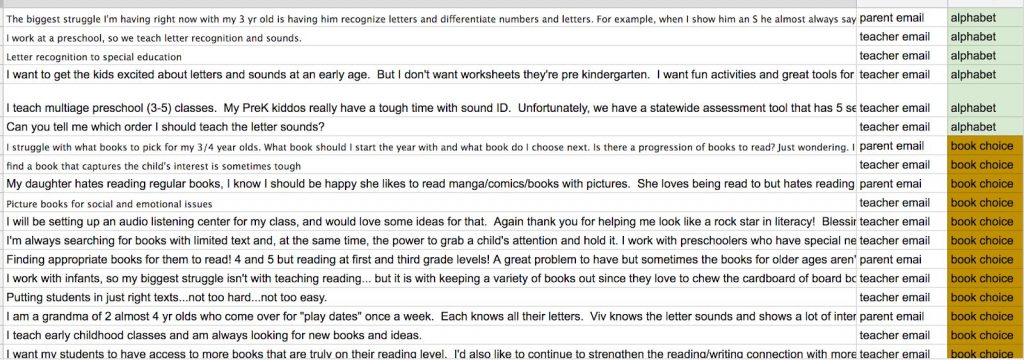
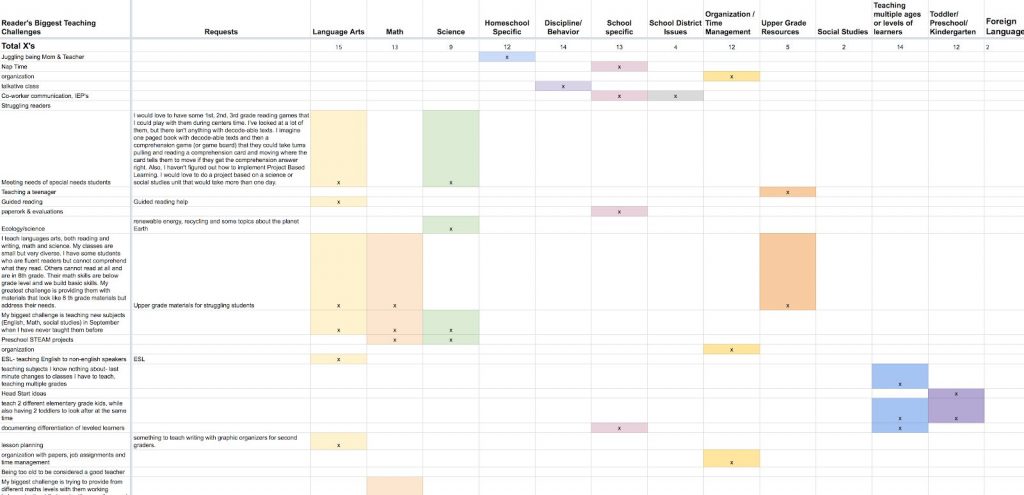
Another option is to create a special section of your Treasure Trove just for these responses so you can analyze them better. Here are a couple examples of spreadsheets former Blog Smarter students used. No need to do something this involved if something simpler works for you. But if you love pretty spreadsheets with color coding, then go for it!
Today, after asking my Golden Question, I got a nice bunch of replies but also a fair number of unsubscribes. Should I be worried?
If you asking a question about their challenges because you want to help them is what caused them to unsubscribe, they weren’t your super fans anyway. They may as well leave now so you can focus on connecting with the people whose wants and needs align with what you have to offer.
I want my Golden Question to be narrow for more specific answers. Should I do that?
The risk is that a narrow Golden Question will not narrow the answers but instead will hinder your readers from answering fully. You want to give them more space to talk about whatever they’re truly struggling with. Remember that if you get an answer and feel there’s more to the story, you can always follow up with more questions or get on a Skype call or Facebook Messenger chat and dig deeper.
Can we tailor the Golden Question for different funnels/sequences?
More details: For instance, if I’m writing a Christmas family tradition post and I have a content upgrade for that post related to family traditions around the holidays, can I put a tailor-made Golden Question for that sequence that still speaks to my brand promise? Something like: ‘What is your biggest struggle with enjoying the holidays with your friends and family each year?’ Clearly this wouldn’t be the more overarching Golden Question, but with a holiday-themed funnel, it could open up some cool possibilities. What do you think?
“Funnel” implies there’s something to buy at the end and that you already have a product in place. In which case, go for it! But if you don’t have a strong brand underneath, you risk muddying the waters of your target market research at this stage. Keep things simple and get some clarity on your target market and Problem Statement before you dive into the deep end.
Do you ever outgrow the Golden Question?
More details: Here’s why I ask. A few months ago I deleted the question from my autoresponder because I was running out of time to answer them all. I know it’s good to build relationships but at some point you get too many, and it takes too much of your time to try to answer them all.
Relationship building remains a top priority, even when you run low on time or get a ton of subscribers. You can mitigate this by continuing to ask the Golden Question but then writing blog posts to answer the questions or address the challenges + use canned e-mail responses (that you can customize just a smidge) to point those readers to those helpful blog posts.
Miscellaneous
I’m not techy at all. Do you recommend anyone for tech or VA help?
We highly recommend Gretchen Louise at gretchenlouise.com for help with tech stuff. She’s a Blog Smarter grad and thoroughly understands this process.
I tagged a leader in my post on the forum and I haven’t gotten any answers from the program leaders yet.
The community leaders will do their best to read/help/comment at different times in the community. In the meantime, an invaluable resource is your teammates. Feel free to tag someone (or a few someones) and ask for extra eyes on your work. Ask questions and help each other. For every question you leave, try to help one of your teammates if you can. This community becomes incredibly valuable when you are all helping each other!
I’m headed to a blog conference during the program. So if I’m not around for a bit, that’s why!
We’ll miss you! Fair warning: conferences can be great for your energy and motivation, but we’ve had a few students in the past get completely derailed from the program because they hear so many competing voices (and so much that goes along with the mainstream “be a good blogger” message).
Here’s my advice: take notes and have a good time, but:
- Listen to EVERYTHING with your Target Market Goggles on. How will this help your target market achieve her goals?
- Mentally assess what you hear and determine to put action on the back burner until the program is over.
You can file all your notes in a folder called “blogging advice” and then after the end of the program, you’ll have your CEO cap firmly in place and will have a GREAT sense for which advice you want to take and what you want to simply keep in that file folder for reference.